
New towns, old problem: fighting clone culture in Britain’s cities

There are many attributes that distinguish cities like London from typical towns, and one is the variety and diversity of shops, outlets and cultural facilities that they offer. Because of London’s long history of growth and expansion and influx of new blood from the rest of the UK and overseas, it boasts a host of peculiarities.
A typical high street in one of London’s many villages may contain a jeweller, a framer, a book shop, a barber or hairdresser, a grocery store, a specialist trader as well as an array of one-off restaurants. This will be in addition to the fast-food, supermarkets and coffee chains that tend to dominate provincial towns.
Given the intense pressure on commercial outlets from increases in business rates, hikes in employers’ National Insurance contributions, rising energy costs, competition from online rivals and the legacy of the Covid-19 pandemic, it is no surprise that some of these outlets are being forced out of business.
The departure of each individual name triggers a howl of anguish. A recent example is the Magma book and art shop in Covent Garden, which will shut in mid-January after 26 years of trading. In their closing statement owners Montse Prats and Marc Valli mourned the “once vibrant, creative retail neighbourhood” they were leaving. They said they were moving out of an area where almost every small, independent retail business had been pushed out and which was now “almost identical to every other high street”.
Clone town
This is what London has traditionally avoided — the rise of what critics have ridiculed as the homogenisation of the high street so far this century. Almost 20 years ago, the New Economics Foundation lambasted what it called Clone Town Britain and urged a return of diversity to our high streets. The austere Royal Geographical Society has even produced a survey to enable people to test their own area.
Two decades ago, this was a provincial issue with every mid-sized town becoming an identikit version of the next. But now, many London high streets are metamorphosing as longstanding outlets close to become yet another branch. A friend worries the barber he has used for decades will close when its Greek Cypriot owner retires and fears it will be replaced by a coffee shop.
Daisy chain
This may explain the huge amount of media attention generated when the City of London Corporation, the UK’s most unusual local council, decided to put the management of four cafes in Hampstead Heath and Golders Green out for tender, in a race won by the Australian café operator Daisy Green.
I am not going to get into the rights and wrongs of a debate that has featured everywhere from BBC London evening TV news to Australia’s vibrant coffee news scene (the fact that actors like Benedict Cumberbatch have come out in opposition to the handover has attracted national British print media).
But many of the opinions raised by 21,000 objectors reflect a concern over the loss of the individual and the conquest by market forces. One café has been run by a local couple for eight years who say they have put their lives into it. Another has been managed by an Italian family for 43 years. As a result, their menus were one-offs.
The fact that Daisy Green has some 20 outlets across London makes it feel like a chain that will bring a menu that can already be found elsewhere. The City of London must have seen this criticism coming as its Q&A states: “Is Daisy Green a chain? No. Daisy Green is an independent London business.” Maybe.
As a fast-growing, wealthy city, it is no surprise that there has been a tide of money flowing into it, bringing new arrivals Farmer J and Blank Street Coffee to join the ranks of GAIL’s, Pret, Costa Coffee and Caffè Nero. But of course, none of the chains landed from a spaceship: Costa began in 1971 when brothers Sergio and Bruno arrived in London, setting up a small roastery in Newport Street and opened their first shop on Vauxhall Bridge Road a decade later. Gerald Ford set up Nero in 1997 and is still a majority shareholder. But life moves on, and Costa is owned by Coca-Cola (which wants to sell, but cannot find a buyer) and Pret by a Luxembourg investment firm.
New town, old place
While the trend of allowing market forces to determine the contents of our cities is likely to continue, there is an opportunity to nurture the growth of more quirky and individual outlets — in the hopefully imminent wave of new towns.
The Government has approved the first batch of 12, based on a shortlist drawn up by the taskforce it set up, including two in the capital: a riverside settlement in Thamesmead, adjacent to the 1960s new town-style development; and an expanded development bringing together Chase Park and Crews Hill in London’s rural north.
There will undoubtedly be fears that the pressure to get these built will allow developers to push ahead with cookie-cutter developments that will include the usual retail suspects. This will be exacerbated by the government’s policy priority to deliver new homes.
But there is hope. The report by the taskforce, which includes economists, housing experts, engineers and planners, sets out principles for “placemaking” — architectural lingo for transforming public spaces into vibrant, healthy and engaging places.
It says each new town should have a clear long-term vision for creating a “well-designed and distinctive place”. They should have their own strong identity and a “distinct feeling of place” that residents can be proud of. These may be buzzwords but, given the amount of effort that went into this vision, the hope is that they translate into a variety of offerings.
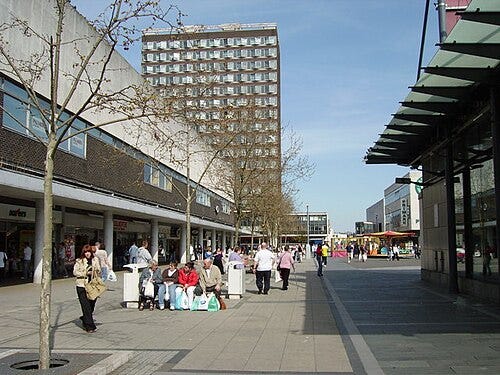
The good news is that the government agrees with the taskforce’s recommendation that the towns should be delivered by development corporations, an echo of those set up for the 32 post-war new towns. While the details need to be set, the hope is that having firm and independent control over how the vision is implemented will prevent clone towns from cropping up elsewhere in England.
Since development corporations will have planning authority over their areas, they can shape retail composition from the ground up. They could cap the number of national chains permitted in primary retail areas, or mandate minimum percentages of independent retailers.
They could offer subsidised or affordable rents for independent start-ups and local businesses, while charging market rates to large chains. And they could ensure that the commercial layouts include smaller, irregular-sized units that favour independent traders.
Development corporations would have special powers in their early formation stage that would allow them to build in protections. These same protections would be extremely difficult — nearly impossible — to add later once the corporations are already established. They should use planning authority, land ownership and long-term stewardship creatively to ensure these new towns develop distinctive identities rather than becoming the clone towns of tomorrow. Perhaps the next generations of new towns will be replete with individual coffee shops, retailers and craft shops. Let’s hope so.